

In response to the multitude of questions that come up on oil consumption, valve cover changes, and de-smogging I wanted to do a write up on the MGB PCV system. I have gone through quite a few trials due to a poorly functioning PCV system. I cannot stress enough the importance of this system and the fact that it should stay on the car.
A poorly functioning system can:
- Cause excessive oil consumption
- Cause oil to blow by gasket and seals
- Poor idle
- Foul the entire breathing side of the engine from carbs to exhaust, including the catalytic converter on later models.
- Decreased efficiency (MPGs)
I've borrowed heavily from an article at British Automotive. I am afraid that with their recent closing this information may disappear into the ether.
So here is a run down of the various crankcase ventilation methods that have been used on the MGB:
MGB 1963 - 1964
This system was basically an "open" system. The tappet chest had a draft tube that was open to the air. The fitting from the valve cover had a 5/32" diameter restrictor in the line that connected to the front air cleaner. A vented oil filler cap was used that had a 1/8" hole in it.
MGB 1965 - early 1968
These years had the first true PCV system. The restricted valve cover connection had disappeared. The tappet chest was connected to a PCV valve which was then connected to the intake manifold. Manifold vacuum controlled the operation of the valve. Oil separation was not very good on this system and you'll often find the valve has oil in it. The oil filler cap had a 5/32" vent on these models.
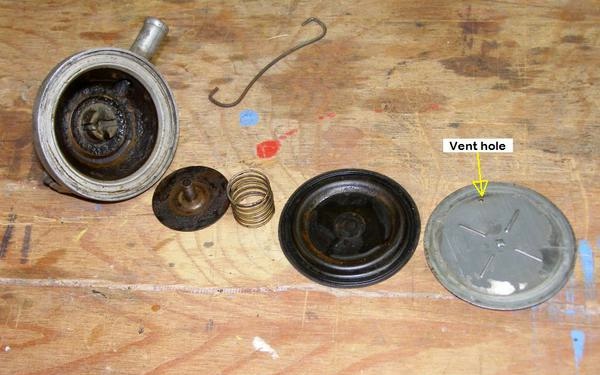
Components of the early MGB PCV (crankcase ventilation) emissions system
MGB Late 1968 - 1969
The PCV valve was retained but redesigned during these model years. The introduction of a direct connection to the carbs via a Y-connector was also made in this revision. The same 5/32" vent in the oil filler cap was present.
MGB 1970 - 1974
The first "closed" PCV system appeared on this revision of the PCV system. There were several changes made to direct crankcase gasses to the carbon canisters and carburetors. First, the vented oil cap was changed to a sealed one. Venting was moved to an elbow on the valve cover. This elbow had a 5/64" restrictor on the end. This piece often goes missing as it was just slipped into the end of the elbow. One can be reconstructed using a 1/2" diameter freeze plug with the 5/64" hole drilled in it. Then it can be pushed into the 1/2" hose that connects to the canister. The PCV valve was deleted and the carburetors were connected directly to the tappet chest via the Y-pipe.
MGB 1975 Onward
This system was the same as the 1970-1974 system except that the single carb no longer required the Y-pipe like the dual carb setup. The direction of the elbow on the valve cover was also rotated 90 degs.
In all cases the valve cover gasket and rubber grommets need to be in good shape and sealing properly to ensure conditions for correct functioning of the PCV system.
In closing, the vent holes in all of these systems must be of correct size and unclogged. Small or clogged vent holes will pressurize the crankcase causing oil to escape any way possible including past the rings and out any oil seals.
Removing the restrictors in the valve cover elbows is also detrimental as oil will quickly be sucked out of the crankcase by the carburetors. Driving for just and hour at speed will suck enough oil out of the system to cause bearing failure! It is also essentially causing a 1/2" vacuum leak. Idle will be poor and an excessively rich mixture will be required to get the car to run properly not to mention the oily mess in your intake system. Rich mixture plus burning oil equals early destruction of a good catalytic converter.
Be good to your engine and make sure it breathes properly.





and no more oil leaks!
says, those diagrams are copyrighted and cannot be reproduced on this website for free.
Want to leave a comment or ask the owner a question?
Sign in or register a new account — it's free